
 By Leo Eric
The global labor market is undergoing a seismic shift driven by technological innovation, automation, and data-driven decision-making. Emerging fields such as artificial intelligence, robotics, renewable energy, and biotechnology are reshaping the nature of employment across every sector. In this rapidly changing economic environment, traditional educational models centered on passive memorization and siloed academic subjects are no longer sufficient.
Science, Technology, Engineering, and Mathematics (STEM) education has emerged as a crucial instructional framework designed to bridge the gap between academic learning and modern workforce needs. By replacing rote learning with integrated, hands-on problem solving, STEM education equips students with the technical competencies, cognitive flexibility, and collaborative skills necessary to thrive in the careers of tomorrow.
The Paradigm Shift: From Siloed Learning to Integrated Education
Historically, schools treated science, mathematics, literature, and history as distinct, isolated subjects. Students learned mathematical formulas in one class and scientific theories in another, rarely exploring how these disciplines intersect in the real world. STEM education dismantles these traditional boundaries by adopting an interdisciplinary, application-based approach.
Real-World Contextualization
In a modern STEM curriculum, concepts are rarely taught in isolation. Instead, science and mathematics serve as foundational tools used to engineer practical technological solutions. For example, rather than simply studying abstract physics equations on a whiteboard, students might apply those principles to design, build, and test a structural bridge model using computer-aided design software. This contextual learning helps students understand not just what a concept is, but why it matters and how professionals utilize it to solve complex real-world challenges.
Experiential and Inquiry-Based Learning
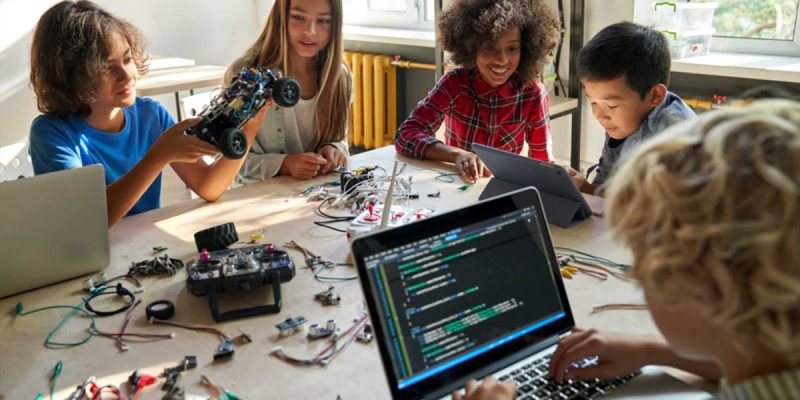
STEM education centers on student inquiry and experiential discovery. Rather than receiving answers directly from a textbook, students are presented with open-ended challenges that require active investigation, experimentation, and analysis. This approach shifts the classroom dynamic from teacher-centered instruction to student-centered exploration, transforming learners from passive consumers of information into active creators and technical problem solvers.
Building Essential Technical Competencies for a Digital Economy
As industries become increasingly digitized, technical literacy is no longer restricted to specialized engineering or computer science departments. Modern workplaces across healthcare, finance, agriculture, and manufacturing require a baseline of digital and analytical literacy. STEM education embeds these core technical capabilities early in a student’s academic journey.
Computational Thinking and Software Literacy
Coding and computational thinking form the foundational literacy of the modern digital landscape. STEM programs introduce students to algorithmic logic, data structures, and software architecture through age-appropriate platforms, progressing from block-based programming in early childhood to text-based languages like Python and Java in secondary education. Learning to write and debug code teaches students how to break down complex, overwhelming problems into manageable, logical sequences.
Advanced Data Literacy and Statistical Analysis
We live in an era governed by vast data streams. The ability to collect, clean, analyze, and interpret quantitative information is one of the most sought-after skills across global industries. STEM education trains students to work with real datasets, utilize statistical tools, and draw evidence-based conclusions. This analytical mindset allows future professionals to identify market trends, optimize operational workflows, and make informed strategic decisions.
Engineering Design Mechanics
The engineering component of STEM introduces students to the iterative design process: defining a problem, researching constraints, brainstorming solutions, prototyping, testing, and refining. Whether designing an automated robotic arm, a water filtration unit, or a clean energy grid, students learn to navigate real-world physical and financial constraints while optimizing performance.
Cultivating High-Value Cognitive and Soft Skills
While technical knowledge is critical, industry leaders consistently report that soft skills—such as adaptability, critical thinking, and team collaboration—are what truly distinguish exceptional job candidates. STEM education provides an ideal environment for cultivating these human-centric cognitive abilities.
-
Critical Thinking and Scientific Rigor: STEM trains students to question assumptions, evaluate evidence objectively, and test hypotheses systematically. This scientific rigor prevents impulsive decision-making and fosters deep analytical reasoning.
-
Collaborative Problem Solving: Modern technical projects are rarely completed by individuals working in isolation. STEM assignments frequently utilize small project teams where students must delegate responsibilities, communicate technical ideas clearly, negotiate differing viewpoints, and work toward a shared objective.
-
Resilience and Iterative Growth: In traditional testing models, failure carries a heavy academic penalty. In a STEM environment, prototype failures and code bugs are treated as necessary data points for improvement. Learning to debug an error, redesign a failed structure, and iterate until success is achieved builds profound psychological resilience and a growth mindset.
-
Cross-Disciplinary Adaptability: Because STEM emphasizes foundational logic and learning how to learn, students develop the mental agility required to adapt to emerging technologies and pivoting career landscapes throughout their lives.
Equalizing Opportunities and Diversifying the Workforce pipeline
Beyond preparing individual students for lucrative career paths, STEM education plays a vital societal role in democratizing economic opportunity and addressing systemic labor shortages.
Closing the Tech Talent Shortage
Global industries face an ongoing shortage of qualified workers in software development, cybersecurity, data analytics, civil engineering, and advanced manufacturing. By integrating rigorous STEM curricula into early K-12 education, schools cultivate early interest in technical fields, creating a steady, well-prepared talent pipeline to power future economic growth.
Expanding Inclusivity and Representation
Historically, underrepresented groups—including women and minority populations—faced systemic barriers to entering STEM professions. Modern STEM initiatives actively focus on early engagement, inclusive mentoring, and accessible learning tools to bridge this demographic gap. Exposing diverse student populations to hands-on technical challenges early in life builds self-efficacy, helping dismantle stereotypes and ensuring that the future workforce reflects a wide range of human perspectives.
Preparing Students for Unscripted Future Careers
Perhaps the most significant value of STEM education lies in its ability to prepare students for jobs that do not yet exist. A decade ago, fields like prompt engineering, commercial drone logistics, automated vertical farming, and renewable energy grid design were in their infancy. As artificial intelligence and automation continue to accelerate, routine manual and cognitive tasks will increasingly be performed by software and machinery.
By focusing on higher-order capabilities—such as creative technological innovation, system architecture, ethical reasoning, and complex problem solving—STEM education ensures that human workers remain irreplaceable. Graduates trained through robust STEM models do not merely memorize current technical manuals; they develop the cognitive framework necessary to invent new industries, navigate unprecedented challenges, and shape the technological future.
Frequently Asked Questions
What does the STEM acronym stand for, and how has it evolved into STEAM or STREAM?
STEM stands for Science, Technology, Engineering, and Mathematics. Over time, educators introduced STEAM to incorporate the Arts, recognizing that creative design, visual communication, and humanities are essential for innovative product development. STREAM further expands the model by incorporating Reading or Research, emphasizing advanced literacy, critical source evaluation, and technical writing skills alongside scientific disciplines.
At what age should STEM education ideally begin in schools?
STEM concepts should ideally be introduced in early childhood education. At the elementary level, STEM focuses on natural curiosity, hands-on play, basic spatial reasoning, simple machines, and foundational problem solving. Early exposure prevents math and science anxiety, fostering a positive, lifelong attitude toward technical subjects before societal stereotypes take root.
How does STEM education benefit students who do not plan to pursue technical or engineering careers?
The benefits of STEM education extend far beyond specialized engineering or coding roles. The core competencies built through STEM—such as analytical reasoning, data literacy, logical problem solving, collaboration, and resilience—are highly valued in law, business administration, journalism, public policy, education, and creative arts.
How can schools with limited budgets implement high-quality STEM programs?
Effective STEM learning does not require expensive high-tech equipment or dedicated robotics labs. High-quality STEM instruction can be delivered using low-cost materials like cardboard, craft supplies, recycled items, and free open-source software platforms. The key to successful STEM education lies in the inquiry-based pedagogical approach and problem-solving framework, not the price tag of the classroom tools.
What role do teachers play in a student-centered STEM classroom?
In a STEM classroom, the teacher transitions from a traditional lecturer to a facilitator, coach, and learning advisor. Instead of providing direct answers, teachers ask guiding questions, help students structure their research, manage collaborative team dynamics, provide safety oversight, and coach students through the iterative process of learning from project failures.
How can parents support STEM learning outside of the classroom environment?
Parents can support STEM education by encouraging curiosity, asking open-ended questions about how everyday objects work, and framing mistakes as learning opportunities. Simple home activities like cooking together to explore measurement and chemistry, building structures with blocks, exploring nature parks, or conducting simple home science experiments foster a supportive STEM learning environment.
How does STEM education address the rapid rise of Artificial Intelligence in the workplace?
STEM education addresses the rise of AI by shifting instructional focus away from tasks machines do well—such as memorizing vast facts or calculating basic equations—toward human-centric capabilities. STEM teaches students how artificial intelligence algorithms operate, how to evaluate AI-generated data critically, how to engineer complex systems, and how to apply human ethics and creativity to technological deployment.
What is your reaction?
Excited
0
Happy
0
In Love
0
Not Sure
0
Silly
0